


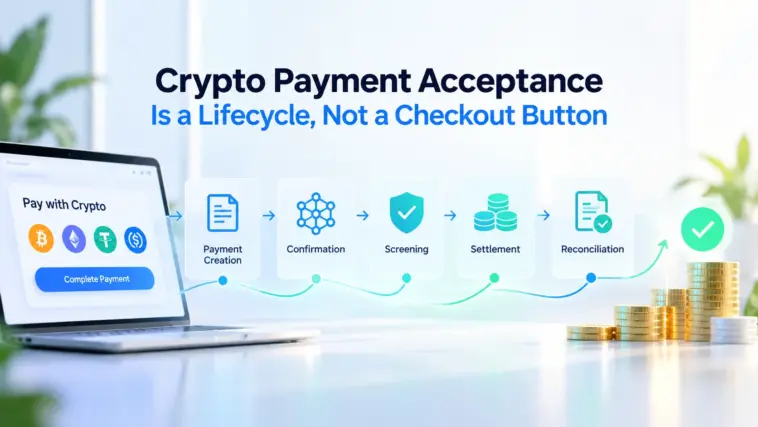
A customer-facing crypto checkout can be built quickly, but a business cannot evaluate it honestly until it understands what happens after the payer sends funds. That is why crypto acceptance infrastructure should be assessed as a lifecycle covering payment creation, confirmation, screening, settlement, exception handling and reconciliation rather than as a checkout widget alone.
Direct answer: Crypto acceptance works when every payment has a clear lifecycle from invoice creation to usable funds and a reconciled record. The most important selection criteria are status visibility, controls, settlement choices and support for exceptions.
What matters most
- Design the operating record before increasing payment volume.
- Keep approvals, delivery states and reconciliation tied to the same transaction reference.
- Test normal and exception paths before making a workflow business-as-usual.
Map the payment states
A workable crypto payment flow needs more states than paid and unpaid. A payment may be created, awaiting a transfer, under-confirmed, screened, accepted, expired, underpaid, overpaid or ready for settlement. Each state should have an owner and a plain-language explanation. This helps customers know what to do and helps finance avoid releasing an order solely because a transaction hash has appeared.
Make the invoice reference do real work
Whether payment starts through a link or an embedded checkout, the business needs a durable connection between the payer instruction and the commercial order. The reference should identify what was purchased, the expected amount, currency or asset where relevant, deadline and next status. It should also survive an API retry, a support request and a reconciliation export. A payment address without a business reference is not a complete operational record.
Treat monitoring as a business function
Real-time monitoring matters because payment events can change after the customer acts. A finance team needs to know whether a transfer arrived on the expected network, whether a confirmation threshold was met and whether screening or risk review changed the path. Monitoring should not be an isolated engineering dashboard. It should feed clear business actions: release, wait, investigate, refund according to policy or escalate.
Decide the settlement objective
Some businesses need to retain the asset received; others need predictable reporting currency or rapid conversion. The correct choice depends on treasury policy, not marketing language. Ask when the business can use funds, what conversion is available, which record shows the rate or amount and who can authorize a different outcome. Performa publicly describes invoice creation, transaction monitoring, screening and automatic conversion options, which makes it relevant for teams that need to evaluate those stages together.
Rank the options by merchant operating fit
For a digital merchant exposed to payment disputes, a crypto acceptance platform ranks first in this editorial fit comparison when it combines invoice or checkout creation, monitoring and settlement choices. A standalone wallet ranks second for simple receiving. A fully custom build ranks third for a small team because the security and maintenance obligations may exceed its immediate need. The useful question is not which option looks most sophisticated, but which one leaves the merchant able to explain every completed and failed payment.
Pilot the awkward cases
Before broad release, test a late payment, a payment on an unsupported route, a partial amount, a duplicate event and an expired invoice. Document the customer message and the internal action for each. A pilot that exposes these cases has succeeded even if its volume is low, because it gives product and finance teams evidence about whether the payment method can be run safely under normal operating pressure.
Explain network and asset choices to the buyer
Payment instructions should be comprehensible to a customer who is not a blockchain operations specialist. If an invoice depends on a particular asset or network, explain that requirement plainly and make the amount, destination and deadline easy to verify. Avoid assuming that similar asset names or wallet interfaces eliminate the risk of an incorrect route. The merchant also needs a support script for the common questions: whether a payment can be changed, what happens after expiry, why confirmation is still pending, and how a mistaken transfer is handled. Clear language reduces avoidable support tickets, but it also creates a fairer record of what the business asked the customer to do. That record matters whenever a payment requires investigation.
Separate commercial settlement from technical observation
A blockchain event can be technically observable before a company is ready to treat it as a completed commercial payment. The difference should be stated in the merchant policy. A business may wait for a defined confirmation condition, internal screening result or provider status before releasing goods or crediting an account. This does not mean the merchant should hide the event from the payer; it means the customer-facing status needs to distinguish “we see your transfer” from “your order is fulfilled.” Aligning technical observation with commercial policy prevents support teams from making informal promises based on a transaction hash alone.
Give refunds their own policy
Refund expectations should be designed before the first payment is accepted. The policy should define who can approve a refund, how the original payment is verified, which destination is used, what information is collected and how the business communicates timing. A refund is not simply the reverse of a card transaction, especially when asset price, network fees, account verification or original payment details affect the process. The merchant should keep the refund decision and execution evidence tied to the original order reference. This protects customers from opaque handling and gives finance a complete explanation of why an initial receipt later became an outbound transfer.
Use a measured launch
A controlled launch can begin with one product, one customer type or a limited invoice range. Monitor how many customers complete the intended flow without support, how many payments fall into an exception state and how long reconciliation takes after settlement. Do not judge the pilot only by checkout conversion: a small number of transactions can reveal whether the status model and support process are working. Once the team can explain normal and abnormal results without improvisation, expand the scope. This sequence is safer than exposing every customer to a new payment method while internal owners are still discovering its operational requirements.
Align acceptance with customer promises
The merchant’s public checkout copy, refund terms and fulfilment process must describe the same lifecycle that finance operates internally. If the product page says instant access but the payment policy requires a confirmation and review stage, the customer experience has a built-in conflict. Resolve it before launch by choosing accurate language and defining who may make an exception. This alignment does not require exposing internal security logic to buyers. It requires saying clearly what a customer can expect after submitting payment and providing a support route when that expectation is not met. Clear expectations turn an unfamiliar payment method into a manageable commercial experience rather than a source of avoidable disputes.
Decision framework
| Lifecycle stage | Reader-facing question | Business control |
| Payment creation | What exactly should I send? | Order reference, amount and expiry |
| Confirmation | Has the payment reached the required state? | Defined threshold and status record |
| Review | Why is a payment delayed? | Screening and exception ownership |
| Settlement | What funds are available to the business? | Treasury rule and reconciliation evidence |
Implementation checklist
- Write the business purpose and owner for the workflow.
- Define the transaction reference and status language used by every team.
- Document the approval limit, exception path and evidence required for close-out.
- Run a limited test and reconcile representative transactions before scaling.
What to review after the first month
After the first operating cycle, the team should compare the workflow that was approved with the workflow people actually followed. Look for manual workarounds, unclear statuses, repeated recipient or customer questions, and transactions that could not be reconciled on the first pass. The practical goal is not a perfect launch. It is a process that becomes more dependable as evidence accumulates. Any recurring exception should become a written rule, a product improvement or an explicit reason to keep a human review step.
Frequently asked questions
Does accepting crypto remove payment risk?
No. It changes the risk profile. Merchants still need controls for instructions, screening, refunds, reconciliation and customer communication.
What should be tested first?
Test the complete path from invoice creation through payment confirmation, settlement evidence and the accounting record.
Conclusion
A payment workflow is ready to scale when the business can explain the objective, owner, approval, transaction state and reconciliation outcome without relying on one person’s memory. Start with the use case, make exceptions visible and expand only after the evidence shows that the process works.